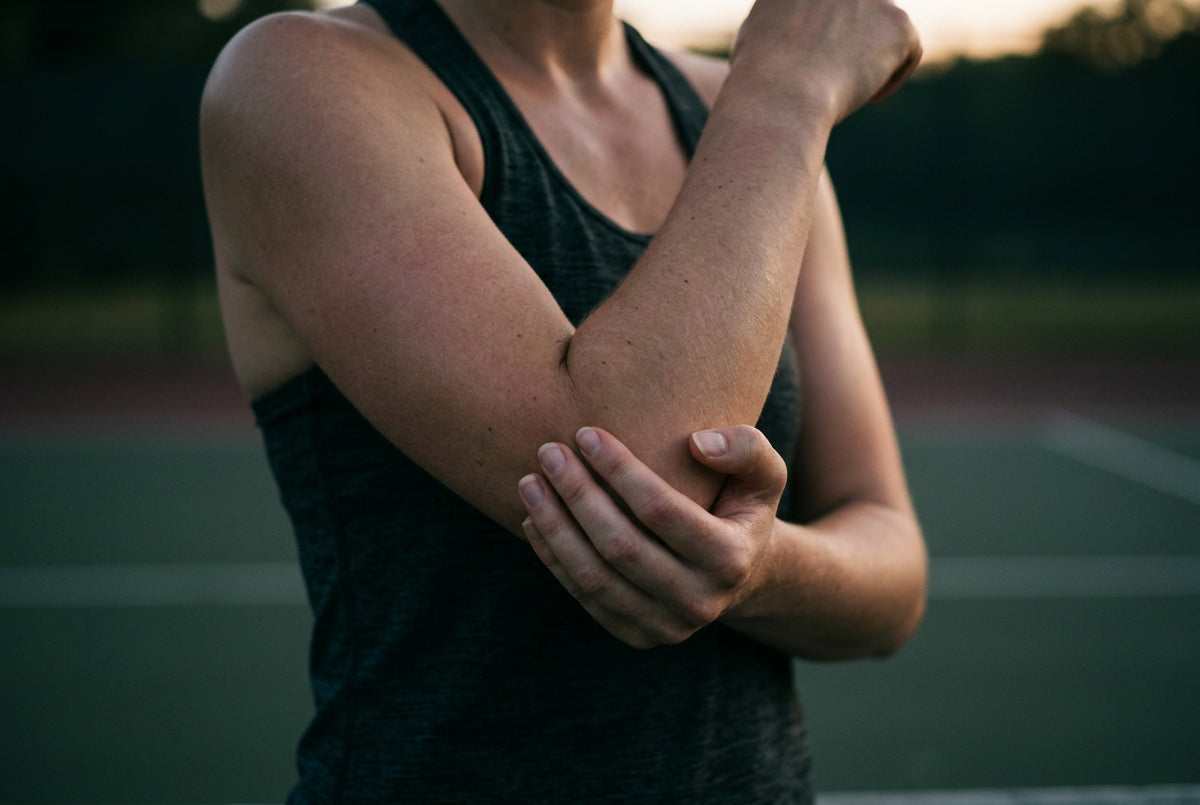
Do tennis elbow straps work? A little, for some people, mostly in the short term. Studies suggest a counterforce strap can ease pain during gripping and daily tasks in the first weeks, but it doesn't beat exercise-based physical therapy in the long run, and the overall evidence is low quality. Think of a strap as a comfort tool that helps you stay active while your elbow settles, not as the thing that gets you better. Below: what the research says, how a strap might work, how to wear one, and who should skip it.
This article is general information, not a diagnosis. Only a physician or physical therapist who examines you can tell you what's going on in your arm.
What is a tennis elbow strap?
A tennis elbow strap (also called a counterforce brace or forearm band) is a band that wraps around the upper forearm, just below the elbow, often with a pad that presses on the muscle. MedlinePlus describes it as a brace that takes some of the pressure off the forearm muscles.[1] AAOS notes that a brace centered over the back of the forearm may help relieve symptoms by resting the muscles and tendons,[2] and the NHS lists a forearm strap as something you can try at home.[3]
Do tennis elbow straps work? The research, study by study
Here's what the better studies found, roughly from strongest to weakest design. Every trial below is about tennis elbow on the outside of the elbow.
| Study | What they did | What they found |
|---|---|---|
| Cochrane review (Struijs et al., 2002)[4] | Pooled the randomized trials on braces and orthoses available at the time | Only 5 small trials; no firm conclusion possible either way |
| Meta-analysis (Shahabi et al., 2020)[5] | 17 studies, 1,145 people | Physical therapy did better than a strap, especially long term. A strap may help pain short term (under 6 weeks), possibly more in people 45 or younger. Results were uncertain (wide confidence intervals) |
| Randomized trial (Struijs et al., 2004)[6] | 180 people: strap, physical therapy, or both | Strap better for daily activities at 6 weeks; physical therapy better for pain and disability. No differences at 6 or 12 months |
| Placebo-controlled trial (Kroslak et al., 2019)[7] | 31 people: real strap vs a placebo strap, double-blind | Both groups improved a lot. The real strap gave less pain at rest at 2–12 weeks and better elbow function at 26 weeks |
| Review of immediate effects (Heales et al., 2020)[8] | 7 crossover trials testing braces on the spot | Low-quality evidence that a forearm strap reduces pain during gripping and improves pain-free grip strength right away. A wrist splint didn't |
| Crossover trial (Bisset et al., 2014)[9] | 34 people tried two strap designs and no brace | Pain-free grip improved in all three conditions, with no difference between braces or no brace |
The honest summary: a strap might take the edge off pain while you grip, mostly in the first weeks. The effect is small and inconsistent, and by six months to a year people do about the same with or without one.[5][6] That last part isn't as bad as it sounds: most tennis elbow improves over time anyway. In a review of untreated and placebo groups from 24 trials, 89% had improved at one year.[10]
How might a strap work?
Nobody knows for sure. The main ideas:
- Moving the pull. The idea is that pressure on the muscle a few inches below the elbow changes where the muscle's pull is focused, taking some strain off the sore tendon attachment. It's a neat theory, but it's hard to measure in a living arm.
- Less muscle activity? In an old lab study with 10 pain-free people, an air-cushion band reduced activity in the wrist extensor muscles above it, but a standard band did not make a significant difference.[11] So that mechanism isn't clearly proven for ordinary straps.
- Touch and pressure. Pressure on the skin may change how the nervous system processes pain signals for a while, similar to rubbing a bumped elbow. This is our plain-language reading of why effects show up immediately, not a proven explanation.
- A reminder. Many people grip a bit more gently when they feel the strap. That's an anecdote, not data, but it's harmless.
How to wear a tennis elbow strap
These are practical tips, not study protocols:
- Position: about 1 to 2 inches (2 to 3 finger-widths) below the elbow crease, on the thickest part of the forearm muscle, not on the elbow bone itself.
- Pad placement: if your strap has a pad, place it over the muscle on the back-outer side of the forearm (the side the knuckles face when your palm is down). That fits AAOS's "centered over the back of your forearm."[2]
- Snug, not tight: you should feel firm pressure when you squeeze your fist, but at rest it should be comfortable. A good check: you can slide one finger under the strap.
- Check your hand: no tingling, numbness, color change, coldness or throbbing. If you notice any of those, loosen it or take it off.
- Wear it when you load the arm: during play, work or heavy chores. Take it off at rest and at night.
- Test it: grip something at the same effort with and without the strap. If it doesn't make gripping more comfortable, you don't need it.
Who should skip a strap (or ask first)
- People with nerve symptoms. Numbness, tingling, burning or weakness in the hand can point to a nerve problem, and pressure from a strap sits close to where the radial nerve runs in the forearm. A case report has described a nerve problem linked to wearing a forearm band.[12] Read tennis elbow vs radial tunnel and get checked first.
- People whose pain gets worse with a strap on. Some people simply feel worse with pressure on the area. Take it off.
- People with circulation problems, swelling, fragile skin or a skin condition under the strap area. Ask your doctor.
- People with pain on the inside of the elbow. We found no strap trials for golfer's elbow. Some people still find a strap comfortable, but the evidence is about the outside of the elbow. See golfer's elbow vs tennis elbow.
Strap vs sleeve vs tape
| Counterforce strap | Compression sleeve | Kinesiology tape | |
|---|---|---|---|
| Where the pressure goes | One focused band below the elbow | Even, all-round compression over the elbow | Light pull on the skin, along or across the muscle |
| Evidence for tennis elbow | Low quality; possible small short-term effect[5][7][8] | Very little: one small lab study found a sleeve and a strap about equally helpful for pain-free grip on the spot[13] | Conflicting; a few small trials show short-term benefit, others show none[14][15] |
| Best for | Gripping during sports or work | People who dislike focused pressure, or want warmth and general support | People who want something thin under a sleeve or glove |
| Downsides | Can slide or feel tight; not for nerve symptoms | Can be hot; sizing matters | Needs skin prep; can irritate skin; lasts a few days |
For a pickleball-specific take on this choice, read pickleball elbow strap vs sleeve.
What matters more than the strap
In the trials above, the people who did best long term were the ones doing exercise-based physical therapy.[5][6] A strap is a sidekick. The main plan usually looks like this: calm the load down (see tennis elbow exercises to avoid), then build forearm strength step by step with the 12-week plan in our tennis elbow complete guide.
Red flags: see a physician or physical therapist
- Numbness, tingling or weakness in the hand, with or without a strap
- The pain started with a fall, a pop or a sudden injury
- A hot, red, swollen elbow, or fever
- Pain at night or steadily getting worse
- No improvement after about 2 weeks of self-care (NHS)[3]
Fun facts and insights
- The placebo strap worked too. In the double-blind trial, people wearing a fake strap also improved a lot. The real one just did a bit better on some measures.[7]
- "No brace" did as well as two brace designs on the spot in one crossover trial. Repeated testing alone made grip less painful.[9]
- Younger people may respond better in the short term, according to one subgroup analysis. That's a hint, not a rule.[5]
Gear that fits this plan
If you want to try one, a simple adjustable forearm strap with a pad is enough; pharmacies and sports stores carry them. Pickleball players can pair it with the exercises in our pickleball elbow guide. No product replaces the exercise plan.
FAQ
Should I wear a tennis elbow strap all day?
Usually not. Most people wear it during activities that load the arm, like play, work or chores, and take it off at rest and at night. Constant pressure isn't needed, and it can irritate skin or nerves. If your clinician advises otherwise, follow that.
Can a strap make tennis elbow worse?
It can if it's too tight, in the wrong place, or if you have nerve symptoms. It can also make it easier to overdo things because pain feels lower. Loosen or remove it if your hand tingles, goes numb, or the pain increases.
Strap or brace: which is better?
For tennis elbow, a forearm strap showed immediate benefits in lab studies, while a wrist splint did not.[8][13] A sleeve and a strap performed similarly in one small study.[13] Comfort and what you'll actually wear matter most.
How long until a strap helps?
If it helps, you'll usually notice right away, during the first few grips. If gripping isn't more comfortable within a day or two of normal use, it's probably not for you.
Do straps prevent tennis elbow?
We found no good evidence that wearing a strap prevents tennis elbow in healthy arms. Gradual load increases, a relaxed grip and forearm strength training are better bets.
Your strap checklist
- Expect a small, short-term comfort boost at best
- Place it 1–2 inches below the elbow crease, pad on the back-outer forearm
- Snug during grip, comfortable at rest, one finger fits under it
- Any tingling or numbness? Take it off and get checked
- Wear it when you load the arm; not at night
- Pair it with the exercise plan, which is what matters most
- Start a simple daily habit with our free 7-day grip plan
Sources
- MedlinePlus (U.S. National Library of Medicine). Tennis elbow. medlineplus.gov
- American Academy of Orthopaedic Surgeons (AAOS), OrthoInfo. Tennis Elbow (Lateral Epicondylitis). orthoinfo.org
- NHS. Tennis elbow (page last reviewed 31 May 2024). nhs.uk
- Struijs PA, Smidt N, Arola H, van Dijk CN, Buchbinder R, Assendelft WJ. Orthotic devices for the treatment of tennis elbow. Cochrane Database Syst Rev. 2002;(1):CD001821. PubMed · doi:10.1002/14651858.CD001821
- Shahabi S, Bagheri Lankarani K, Heydari ST, Jalali M, Ghahramani S, Kamyab M, et al. The effects of counterforce brace on pain in subjects with lateral elbow tendinopathy: a systematic review and meta-analysis of randomized controlled trials. Prosthet Orthot Int. 2020;44(5):341-354. PubMed · doi:10.1177/0309364620930618
- Struijs PA, Kerkhoffs GM, Assendelft WJ, Van Dijk CN. Conservative treatment of lateral epicondylitis: brace versus physical therapy or a combination of both: a randomized clinical trial. Am J Sports Med. 2004;32(2):462-469. PubMed · doi:10.1177/0095399703258714
- Kroslak M, Pirapakaran K, Murrell GAC. Counterforce bracing of lateral epicondylitis: a prospective, randomized, double-blinded, placebo-controlled clinical trial. J Shoulder Elbow Surg. 2019;28(2):288-295. PubMed · doi:10.1016/j.jse.2018.10.002
- Heales LJ, McClintock SR, Maynard S, Lems CJ, Rose JA, Hill C, et al. Evaluating the immediate effect of forearm and wrist orthoses on pain and function in individuals with lateral elbow tendinopathy: a systematic review. Musculoskelet Sci Pract. 2020;47:102147. PubMed · doi:10.1016/j.msksp.2020.102147
- Bisset LM, Collins NJ, Offord SS. Immediate effects of 2 types of braces on pain and grip strength in people with lateral epicondylalgia: a randomized controlled trial. J Orthop Sports Phys Ther. 2014;44(2):120-128. PubMed · doi:10.2519/jospt.2014.4744
- Ikonen J, Lähdeoja T, Ardern CL, Buchbinder R, Reito A, Karjalainen T. Persistent tennis elbow symptoms have little prognostic value: a systematic review and meta-analysis. Clin Orthop Relat Res. 2022;480(4):647-660. PubMed · doi:10.1097/CORR.0000000000002058
- Snyder-Mackler L, Epler M. Effect of standard and Aircast tennis elbow bands on integrated electromyography of forearm extensor musculature proximal to the bands. Am J Sports Med. 1989;17(2):278-281. PubMed · doi:10.1177/036354658901700222
- Enzenauer RJ, Nordstrom DM. Anterior interosseous nerve syndrome associated with forearm band treatment of lateral epicondylitis. Orthopedics. 1991;14(7):788-790. PubMed · doi:10.3928/0147-7447-19910701-11
- Jafarian FS, Demneh ES, Tyson SF. The immediate effect of orthotic management on grip strength of patients with lateral epicondylosis. J Orthop Sports Phys Ther. 2009;39(6):484-489. PubMed · doi:10.2519/jospt.2009.2988
- George CE, Heales LJ, Stanton R, Wintour SA, Kean CO. Sticking to the facts: a systematic review of the effects of therapeutic tape in lateral epicondylalgia. Phys Ther Sport. 2019;40:117-127. PubMed · doi:10.1016/j.ptsp.2019.08.011
- Giray E, Karali-Bingul D, Akyuz G. The effectiveness of kinesiotaping, sham taping or exercises only in lateral epicondylitis treatment: a randomized controlled study. PM R. 2019;11(7):681-693. PubMed · doi:10.1002/pmrj.12067
Watch: exercise demonstrations
- British Elbow & Shoulder Society (BESS): Exercises for Tennis Elbow (about 9 min). The exercise program that should do the heavy lifting, with or without a strap.
- Physiotutors: Lateral Epicondylalgia Exercises – Tennis Elbow Rehab (about 8 min). Physiotherapist educators explain loading progressions, with references in the description.
Last updated: October 2026 · v1.1
Gripkind products are fitness and comfort accessories, not medical devices. They are not intended to diagnose, treat, cure or prevent any disease.