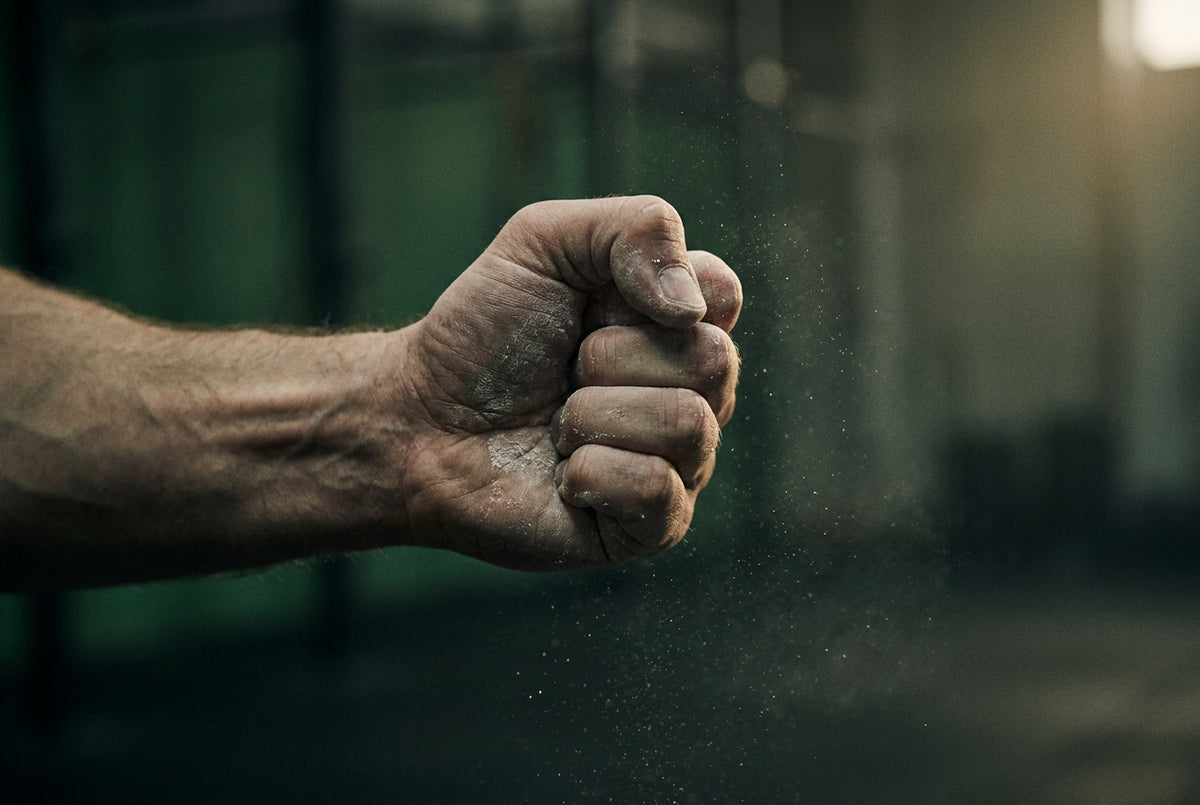
A strong grip helps you lift more, carry groceries in one trip, open jars, hold a racket or club with control, and stay independent as you age. The good news: your grip responds fast to training. This guide shows you how to build grip strength step by step, from a towel and a pull-up bar to heavy grippers and armwrestling-style wrist work, with weekly schedules for each level and the rules that keep your elbows happy.
The four types of grip
"Grip" isn't one thing. Training one type helps the others a little, but each responds best to its own work.
| Type | What it is | Everyday example | Typical training |
|---|---|---|---|
| Crush | Closing your hand hard around something | Handshake, squeezing a tube | Hand grippers, towel wringing |
| Support | Holding on to something for a long time | Carrying bags, deadlifts, hanging | Dead hangs, farmer's carries, holds |
| Pinch | Squeezing between your fingers and thumb | Carrying a plate, lifting a box by its edge | Plate pinches, block pinches |
| Wrist & forearm | Controlling the wrist and rotating the forearm | Turning a key, swinging a hammer or racket | Wrist roller, lever bar, wrist curls, pronation/supination |
Don't forget the opposite side. The muscles that open your hand and lift your wrist (the extensors) steady the wrist while you squeeze. They get little work from normal grip training, so we add them on purpose.
How your grip gets stronger
Knowing how grip adapts tells you how fast to push.
- Weeks 1 to 4: your nervous system learns. Early strength gains come largely from better muscle activation and coordination. That's why beginners often improve quickly.
- Weeks 4 to 12 and beyond: muscle grows. The forearm muscles get bigger and stronger with steady, progressive training. The American College of Sports Medicine's 2026 position stand found that strength grows best with fairly heavy loads, full range of motion, 2 to 3 sets, and at least two sessions a week [1].
- Months: tendons catch up. Tendons do adapt to training. They get stiffer and more robust, and the size of the load matters most [2]. But tendon tissue responds more slowly than muscle [2][3]. That gap is why people who jump to heavy grippers too fast often end up with sore elbows.
Bottom line: your muscles will feel ready before your tendons are. Progress on a schedule, not on enthusiasm.
Wrist position matters
Your hand is strongest with the wrist slightly bent back (extended). In a classic hand-surgery study, people naturally gripped with the wrist about 35 degrees extended, and their grip got clearly weaker when the wrist was forced into other positions [4]. For most crush and support work, keep a firm, slightly extended wrist. Don't let it curl forward under load.
Warm-up (5 minutes, every session)
- Wrist circles: 10 each way.
- Fist-to-spread: make a tight fist, then spread your fingers wide. 15 reps.
- Forearm rotations: elbow at your side, turn the palm up and down. 15 reps.
- Finger extensions against a light band: 15 reps.
- Ramp-up sets: one or two easy sets of your first exercise at about half effort.
Level 1: Beginner (no equipment needed)
Who it's for: you're new to grip training, or you haven't lifted in a while. Stay here for at least 4 to 6 weeks.
Towel wring
Roll up a dry hand towel. Grip it with both hands and twist hard in one direction, as if you were wringing out water. Hold 5 seconds, then twist the other way. Do 3 sets of 5 twists each way. Wet towels add resistance.
Dead hang
Hang from a pull-up bar with a shoulder-width, overhand grip, arms straight and shoulders gently engaged (not shrugged up to your ears). If you can't hang yet, keep your feet on a box or the floor and take part of your weight. Build up to 3 hangs of 30 to 60 seconds.
Farmer's carry
Pick up two heavy objects (dumbbells, kettlebells, full water jugs, loaded grocery bags) and walk tall for 30 to 40 yards (about 30 to 40 m). Start with a weight you can carry without stopping, then progress to something that challenges your grip by the end.
Towel hang or towel row (optional)
Drape a towel over a bar and hang from the ends, or loop it around a sturdy pole and row yourself toward it. A towel makes support grip much harder, so use short holds.
Finger extensions
Put a thick rubber band around your fingers and thumb and open your hand against it. 2 to 3 sets of 15 to 25 reps. This keeps the muscles on both sides of the forearm working.
| Beginner week | Exercises | Sets × reps / time |
|---|---|---|
| Monday | Dead hang · Towel wring · Finger extensions | 3 × 20–40 s · 3 × 5 each way · 2 × 20 |
| Wednesday | Farmer's carry · Towel hang or row · Finger extensions | 3 × 30–40 yd · 3 × 10–20 s or 3 × 8 · 2 × 20 |
| Friday | Dead hang · Towel wring · Finger extensions | 3 × 20–40 s · 3 × 5 each way · 2 × 20 |
| Other days | Rest, or easy finger extensions | 1 × 25 |
Ready to move up when: you can hang for 60 seconds, carry roughly a quarter of your body weight in each hand for 40 yards, and you've trained pain-free for four weeks.
Level 2: Intermediate (simple tools)
Who it's for: you've done 1 to 3 months of consistent training, or you already lift weights.
Adjustable hand gripper
Crush strength responds best to grippers. An adjustable hand gripper lets you increase resistance in small steps instead of making big jumps between fixed grippers. Set it so you can fully close it for 8 to 12 reps. Squeeze until the handles touch, hold for 1 to 2 seconds, then open slowly. Do 3 sets per hand.
Wrist roller
Hold a wrist roller at shoulder height with arms straight, and roll a light weight all the way up and slowly back down. Then reverse direction. This trains the wrist flexors and extensors over a long range. Start with 5 to 10 lb (2 to 5 kg); it burns more than you'd expect. Do 2 to 3 rounds up and down each way.
Fat grips
Thick handle attachments make normal exercises like rows, curls and carries much harder on your hands. In one study of trained lifters, a 2-inch-thick bar cut their maximum deadlift by about 28% and a 3-inch bar by about 55% [5]. So drop the weight when you add them. Use them on one or two exercises per session, not on everything.
Plate pinch
Hold two smooth weight plates together, smooth sides out, between your fingers and thumb. Stand and hold for 15 to 30 seconds. 3 sets per hand.
Extensor and wrist work
- Band finger extensions: 2 to 3 sets of 20 to 25.
- Reverse wrist curls: forearm on your thigh, palm down, light dumbbell. Lift the back of your hand slowly. 2 to 3 sets of 15.
- Hammer rotations: hold a hammer or a dumbbell by one end and slowly turn your palm up and down. 2 sets of 12.
| Intermediate week | Exercises | Sets × reps / time |
|---|---|---|
| Day A (Mon) | Hand gripper · Plate pinch · Reverse wrist curl · Finger extensions | 3 × 8–12 per hand · 3 × 15–30 s · 2 × 15 · 2 × 20 |
| Day B (Wed) | Fat grip rows or carries · Wrist roller · Hammer rotations | 3 × 8–10 or 3 × 30 yd · 2–3 rounds · 2 × 12 |
| Day C (Fri) | Hand gripper (heavier, fewer reps) · Dead hang (weighted or one-arm assisted) · Finger extensions | 4 × 5–6 per hand · 3 × 20–40 s · 2 × 20 |
| Other days | Rest or light finger extensions | 1–2 × 25 |
Ready to move up when: you've trained consistently for 3 months or more, your gripper is near its maximum setting, and your elbows and wrists feel fine the morning after training.
Level 3: Advanced
Who it's for: experienced lifters, climbers, armwrestlers, and anyone who has outgrown the basics. Volume stays modest here; intensity goes up.
Heavy grippers
Heavy-rated torsion grippers are a big step up from adjustable ones. Work in low reps (3 to 5) and use a "set" technique: position the gripper in your hand so it's partly closed before you squeeze. Add negatives: close the gripper with two hands, then resist it opening with one hand for 3 to 5 seconds. Negatives are very taxing, so use them once a week at most.
Pinch blocks and wide pinch
Load a pinch block or use wider plates. Train 3 to 5 heavy pinch holds of 5 to 10 seconds per hand.
Rotating and thick handles
Rotating handles (like a loaded thick handle that spins) and revolving bars force your hand to fight the spin. Use them for short, heavy holds or carries of 10 to 20 seconds.
Armwrestling-style wrist work: rising and pronation
- Rising (radial deviation): hold a loading pin or a weighted handle by one end, thumb up, with the weight in front of your hand. Lift the end of the handle toward the ceiling by tilting your wrist, without bending the elbow.
- Pronation: attach a band or cable to a handle, elbow bent, and turn your palm down against the resistance.
Start these light: 3 sets of 10 to 12 slow reps. Small wrist muscles and tendons don't like sudden jumps in load.
Loading pin
A loading pin is a short bar you load with plates and lift with handles, blocks or straps. It makes it easy to add weight in small steps for pinch, wrist and thick-handle work. Use it for heavy holds (3 to 5 sets of 5 to 10 seconds) and for rising.
Lever bar
A forearm lever bar (or a sledgehammer held near the end) trains wrist control in every direction. Move it slowly; the longer the lever, the heavier it feels.
| Advanced week | Focus | Example |
|---|---|---|
| Day A (Mon) | Heavy crush + pinch | Heavy gripper 5 × 3–5 per hand · Pinch block 4 × 5–10 s · Finger extensions 2 × 25 |
| Day B (Wed) | Wrist & forearm | Rising 3 × 10 · Pronation 3 × 10 · Wrist roller 2 rounds · Reverse wrist curl 2 × 15 |
| Day C (Fri) | Support + thick/rotating handles | Rotating handle holds 4 × 10–20 s · Fat grip farmer's carry 3 × 30 yd · Gripper negatives 3 × 3 (optional) |
| Day D (Sat, optional) | Light volume | Gripper at 60% effort 3 × 10 · Dead hang 2 × 30–45 s · Finger extensions 2 × 25 |
Every 4 to 6 weeks, take a lighter week with about half the usual sets.
Progression rules
- Use double progression. Pick a rep range (for example 8 to 12). When you hit the top of the range on all sets, increase resistance slightly and work back up.
- Change one thing at a time. Add weight or sets or a new exercise in a given week, not all three.
- Small steps. Increase load by about 5 to 10% at a time. Grippers jump in big steps, which is why adjustable models help.
- Leave 1 to 2 reps in the tank on most sets. The ACSM review found that training to failure did not reliably improve results [1], and grinding every set wears on your tendons.
- Train grip 2 to 4 times a week. Hard sessions need at least a day between them.
- Track your numbers. Write down settings, reps and hold times. If you own a dynamometer, test every 4 weeks.
Recovery and tendon care
Most grip-training problems are overuse problems. Pain on the outside of the elbow (often called tennis elbow) or the inside (golfer's elbow) usually shows up after a sudden jump in volume, not after one bad set.
- Respect the tendon timeline. Tendons adapt to load, but slowly [2][3]. Keep weekly volume increases small, especially in the first three months.
- Balance flexors and extensors. Most grip work trains the muscles that close the hand. Finger extensions and reverse wrist curls train the other side. Many coaches and therapists recommend this balance. The research on whether it prevents elbow pain is limited, but it's low-risk and easy to add. Finger extensor bands, or a thick rubber band around your fingertips, are a simple way to do it.
- Mind your total hand load. Climbing, deadlifts, pull-ups, racket sports, tools and a long day of typing all count. On heavy days, cut back on extra grip work.
- Sleep and eat enough protein. Recovery happens between sessions.
- Use a simple pain rule. Mild discomfort during training that settles by the next morning is usually fine. Pain that gets worse during a session, or is worse the next day, means you need to reduce the load.
See a doctor or physical therapist if pain lasts more than two weeks despite reducing load, you have numbness or tingling in your fingers, swelling, a pop or sudden pain, or weakness that keeps getting worse. If your forearms already hurt from desk work, start with our 5 forearm exercises for desk workers. For elbow pain, read our tennis elbow guide before adding grip training.
Common mistakes
- Buying the heaviest gripper first. If you can't fully close it, you're mostly training frustration. Start where you can do 8 to 12 full reps.
- Squeezing every day at maximum effort. Grip recovers fast, but tendons don't. Hard days need easy days.
- Only training crush. A great handshake doesn't help you carry or pinch. Train all four types.
- Ignoring the extensors. A few minutes a week on the opening side is cheap insurance.
- Letting the wrist collapse. A curled wrist weakens your grip [4] and stresses the forearm. Keep it firm and slightly extended.
- Straps on every pulling set. Straps are useful for very heavy work, but if you always use them, your grip never has to catch up.
- Training through sharp pain. That's a signal, not a challenge.
FAQ
How long does it take to build grip strength?
Most beginners notice a difference within 3 to 4 weeks, mostly from better muscle activation. Bigger, lasting gains in muscle and tendon take several months of steady training.
How often should I train grip?
Two to three focused sessions a week is plenty for most people. Advanced lifters can add a fourth, lighter day. Strength in general improves best with at least two sessions a week [1].
Do hand grippers alone build a strong grip?
They build crush strength very well, but not much support, pinch or wrist strength. Combine them with hangs, carries and wrist work.
Are dead hangs good for grip?
Yes, for support grip and for your shoulders. They're one of the best no-equipment grip exercises. Scale them with your feet on the floor if needed.
Can grip training cause tennis elbow?
Doing too much, too soon can overload the forearm tendons. Build up gradually, train the extensors, and reduce load if pain lingers into the next day.
Should I train my weaker hand more?
A small difference between hands is normal; your dominant hand is often a bit stronger. Train both equally. If one hand is much weaker or suddenly gets weaker, have it checked.
Does grip strength matter for health?
Yes, as a marker of overall strength. Big studies link stronger grip with lower risk of early death, but that's a link, not proof that grip training adds years. Read more in Grip Strength and Longevity: What the Science Says.
Your plan for this week
- Pick your level honestly. When in doubt, start one level lower.
- Put three grip sessions in your calendar (for example Monday, Wednesday, Friday).
- Write down your starting numbers: hang time, carry weight, gripper setting, or a dynamometer score.
- Add finger extensions to every session.
- Want a day-by-day start? Get our free 7-day grip plan.
- Re-test after 4 weeks and use the progression rules above.
Curious how you compare? See our chart of grip strength by age.
Sources
- Currier BS, D'Souza AC, Singh MAF, et al. American College of Sports Medicine Position Stand. Resistance training prescription for muscle function, hypertrophy, and physical performance in healthy adults: an overview of reviews. Med Sci Sports Exerc. 2026;58(4):851-872. PubMed · DOI
- Bohm S, Mersmann F, Arampatzis A. Human tendon adaptation in response to mechanical loading: a systematic review and meta-analysis of exercise intervention studies on healthy adults. Sports Med Open. 2015;1(1):7. PubMed · DOI
- Magnusson SP, Kjaer M. The impact of loading, unloading, ageing and injury on the human tendon. J Physiol. 2019;597(5):1283-1298. PubMed · DOI
- O'Driscoll SW, Horii E, Ness R, Cahalan TD, Richards RR, An KN. The relationship between wrist position, grasp size, and grip strength. J Hand Surg Am. 1992;17(1):169-177. PubMed · DOI
- Ratamess NA, Faigenbaum AD, Mangine GT, Hoffman JR, Kang J. Acute muscular strength assessment using free weight bars of different thickness. J Strength Cond Res. 2007;21(1):240-244. PubMed · DOI
Watch
- Bob & Brad (physical therapists): 10 Best Hand, Wrist, Grip, & Forearm Strengthening Exercises at Home. Useful demonstrations of beginner-friendly hand and wrist exercises with household items.
- Bob & Brad: Top 10 Grip Strengthening Exercises for Ages 50+ (Worst to Best). Shows towel wringing, pinch holds, the wrist roller, farmer's carries and dead hangs.
- Hooper's Beta (Dr. Jason Hooper, physical therapist for climbers): Basic Wrist Stability Training for Climbers | Bulletproof Wrists Pt. 1. A good next step for intermediate and advanced lifters who want stronger, more stable wrists.
Last updated: October 2026 · v1.1