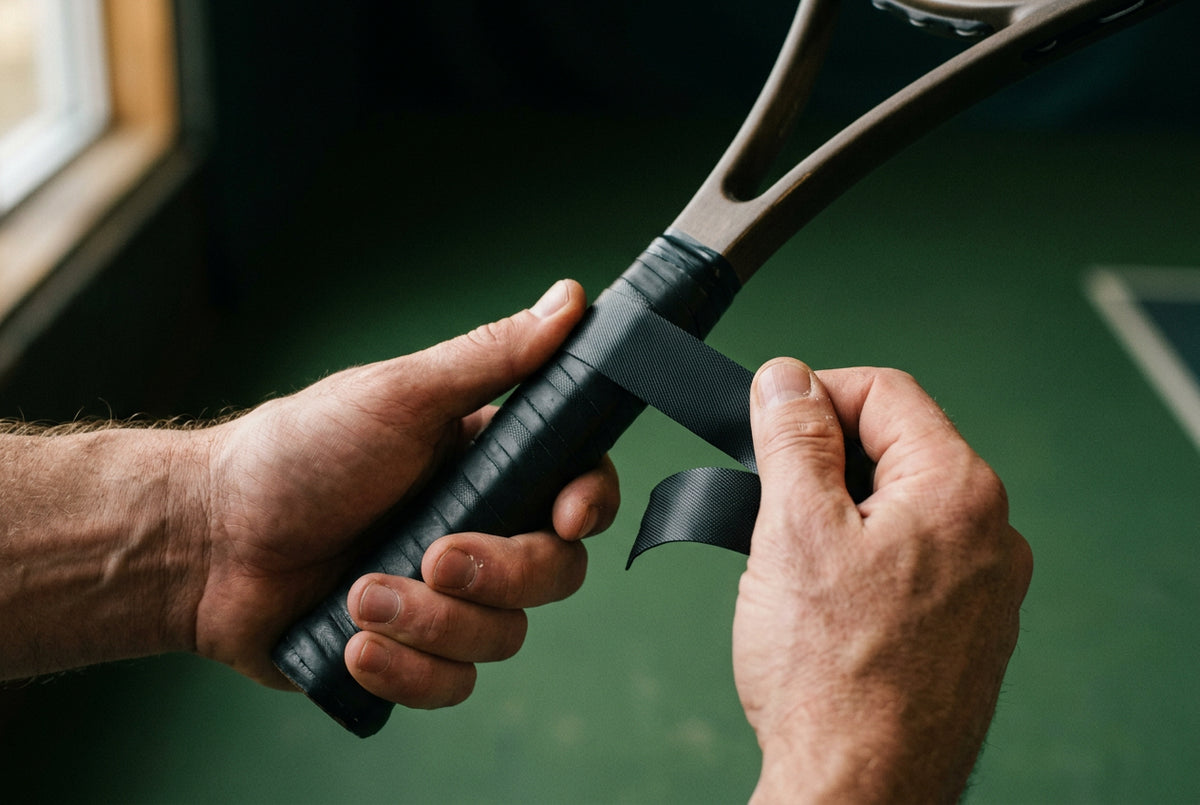
Partly true. A handle that fits your hand, plus a fresh, tacky overgrip, can let you hold your racket or paddle with less squeeze, and a looser hold puts less load on the forearm muscles that attach at the outer elbow. That part fits the lab research on grip size and tennis elbow. What nobody has shown is that an overgrip or a thicker handle prevents or eases elbow pain in real players. And thicker isn't automatically better: too big strains the arm too. Below: the evidence, your grip size, overgrip options, and how tight to hold.
This article is general information, not a diagnosis. If your elbow hurts, a physician or physical therapist can tell you what's going on.
The quick answer
- Likely true: the tighter you squeeze, the harder the wrist and finger extensors work. A handle that's too small or too slippery makes you squeeze harder.[2][13][14]
- Plausible, not proven: a tacky overgrip helps you hold on with less effort and feels nicer. No study has tested whether that protects your elbow.
- Not true: that a thicker handle is always better. One old survey linked larger grips to more tennis elbow in older players.[5]
- Bigger levers: how much you play, back-to-back days, technique, and a relaxed grip.[1][5][6]
What the research on grip size and tennis elbow actually shows
Almost all of it comes from small tennis lab studies. Nobody has studied pickleball paddle grip size yet.
| Study | What they found | What it means for you |
|---|---|---|
| French lab study, tennis players, 3 handle sizes (2014) | One handle size needed the least grip force during strokes, rested or tired. A hand model linked lower grip force to less load on the wrist extensors.[2] | Fit matters. There's a "best" size per player, not one magic size. |
| 16 college players, fine-wire EMG (2006) | Going 1/4 inch smaller or bigger than the recommended size made no significant difference in forearm muscle activity on backhands.[3] | Small mismatches may matter less than you'd think. |
| Grip sizes 4 1/4, 4 1/2 and 4 3/4 in (1986) | Forearm extensor and shoulder muscle activity changed as grip size changed.[4] | Size can shift muscle effort. Small, old study. |
| 500+ recreational players (1979) | Age and daily playing time were the main factors. A larger grip was linked to more tennis elbow in the older group.[5] | "Thicker is better" is not a safe rule. |
| Clamped rackets, cushioned grip tape (1995) | Cushioned grip tape increased racket damping by up to 100% and cut the measured grip reaction force by about 20%. The rackets were clamped; no human hand was involved.[10] | Soft grip material can absorb some shock, at least on a test rig. |
| 20 players, string dampers (2004) | Those little rubber dampers on the strings did not reduce vibration reaching the forearm.[11] | Not every "anti-vibration" gadget does what it says. |
One more thread ties it together: how hard you squeeze shapes how much shock and vibration travel up your arm. In one lab study of expert players, grip force mattered more for the vibration reaching the arm than the racket did.[9] Where you hit the ball matters too: off-center hits sent about three times more vibration into the arm than center hits.[12] In a computer simulation of one-handed backhands, a tight grip on an off-center hit gave about 20% more wrist extension torque than a normal grip.[7]
Why a slippery or too-small handle makes you squeeze harder
Your hand automatically matches its squeeze to friction: the more slippery the surface, the harder you grip, often without noticing.[13][14] A worn, sweaty grip is slippery; a fresh, tacky overgrip needs less squeeze for the same shot. That's the best reason an overgrip can feel easier on the arm. It just hasn't been tested on players' elbows.
Size works the same way. On a too-small handle, your fingers wrap too far and the racket wants to twist, so you clamp down. On a too-big handle, you work harder to control it and change grips. Britain's tennis federation (LTA) notes that a poorly fitting grip can contribute to tennis elbow.[17] Tool research agrees: grip force depends on how handle size matches hand size, and one hand model put the "least effort" diameter at about 33 mm, just over 4 inches around.[15][16]
How to find your grip size
The common method (used by racket makers and tennis federations, not a medical test):[17]
- Open your playing hand, fingers together.
- Put a ruler on the lower crease of your palm.
- Measure to the tip of your ring finger, in inches.
- Match the number to the table. Between two sizes? Pick the smaller one and add an overgrip.
| Your measurement | Grip size (US / Europe) | Often used by |
|---|---|---|
| About 4 in | 4 in / 0 | Juniors, small hands |
| About 4 1/8 in | 4 1/8 in / 1 | Smaller adult hands |
| About 4 1/4 in | 4 1/4 in / 2 | Many women |
| About 4 3/8 in | 4 3/8 in / 3 | Many men |
| About 4 1/2 in | 4 1/2 in / 4 | Larger hands |
| About 4 5/8 in or more | 4 5/8 in / 5 (and 4 3/4 / 6, rare) | Extra-large hands |
Source: Lawn Tennis Association size chart.[17] Typical users are a rough guide, not a rule.
Tennis check: hold the racket in your normal forehand grip. The index finger of your other hand should just fit in the gap between your ring fingertip and your palm. No room means too small; lots of room means too big.[17]
Pickleball: paddle handles use the same inch scale. Paddle makers (industry guidance, not research) mostly offer about 4 to 4 1/2 inches, and some suggest a rough height rule: under 5'3" about 4 in, 5'3" to 5'8" about 4 1/4 in, over 5'8" about 4 1/2 in. The ruler method is more accurate.
Overgrip vs. replacement grip vs. build-up
| Option | What it is | Adds about | Best for |
|---|---|---|---|
| Overgrip | Thin, tacky wrap over your existing grip | 1/16 in (half a size)[17] | Tack, sweat, comfort, small size bump. Cheap and easy to change. |
| Replacement grip | Swaps the cushioned base grip | Depends on the grip | A worn, flat or hard base grip; more cushioning |
| Build-up (heat-shrink sleeve) | Sleeve under the base grip | 1/8 in (one full size)[17] | Handle clearly too small |
How many overgrips? A common rule of thumb: no more than two. Two overgrips add about 1/8 inch, a full size.[17] Need more? Use a build-up sleeve or a bigger handle; stacked wraps get lumpy. In pickleball, grip wraps are a permitted player alteration; tape can't extend more than 1 inch above the top of the grip.[18]
When to replace: regular players often change the overgrip every 5 to 10 hours of play, or as soon as it loses its tack, frays, stays soaked or goes hard and flat.[17] A dead overgrip is a slippery overgrip, and slippery means more squeeze.
Squeeze at 3–4 out of 10
A coaching rule of thumb, not a trial result: if 10 is your hardest squeeze, hold at about 3 or 4 between shots and firm up only around contact. The research points the same way:
- Pickleball players who held a tight grip at the baseline had about 2.7 times the risk of a sudden arm injury in one survey of 253 players. That was for acute injuries, not slow-building elbow pain.[1]
- Experienced tennis players relaxed their forearm muscles after impact, while recreational players kept them near maximal, and they passed more shock to the elbow.[8]
- Grip force before impact was one of the strongest predictors of the force loading on the hand afterwards.[6]
Quick test: someone should be able to pull the paddle out of your hand between points without a fight.
Is it true for pickleball too?
Probably, but untested. Pickleball elbow is usually the same tendon problem as tennis elbow (see our pickleball elbow guide). Harvard Health advises a paddle grip that's not so narrow you have to clench it.[19] MedlinePlus and the AAOS both list checking your racket and grip as part of managing sports-related tennis elbow.[20][21]
Red flags: see a professional
New grip or not, see a physician or physical therapist if:
- The pain started with a fall or a pop, or the elbow is swollen or looks deformed
- You have numbness, tingling or real weakness in the hand
- The pain wakes you at night, or you feel feverish or unwell
- It keeps getting worse, or there's no improvement after a few weeks of easing off
Pain mainly in the shoulder or upper arm? Read our pickleball shoulder guide.
Your grip checklist
- Measure: lower palm crease to ring fingertip
- Between sizes? Go smaller, add one overgrip
- Maximum two overgrips; need more? Build up or size up
- Fresh overgrip every 5–10 hours, or when it's slick
- Squeeze at 3–4 out of 10, firm only at contact
- Watch volume: no back-to-back hard days when your arm is grumpy[1]
- Build forearm strength off court with the routine in our tennis elbow guide
- Start a simple daily habit with our free 7-day grip plan
Gear that fits this plan
An overgrip costs a few dollars at any sports store. It won't build a stronger tendon, though; gradual loading does. If you also want to train your forearm off court, follow the exercises in our pickleball elbow guide; a light dumbbell or a flexible rubber bar is all you need.
Fun facts
- Your hand reads friction in a tenth of a second. Skin sensors adjust your squeeze to how slippery an object is in about 0.1 seconds.[14]
- The string damper is mostly about sound. Researchers concluded it's popular for its acoustics and "psychological support."[11]
FAQ
Does an overgrip help tennis elbow?
It may make holding the racket easier: a tacky surface lets you grip with less force, and less squeeze means less work for the forearm extensors. But no study has tested overgrips on people with tennis elbow. See it as a comfort and fit tool, alongside load management and exercise, not as treatment.
Is a thicker grip better for pickleball elbow?
Only if your current grip is too small. A handle that fits lets you hold with less effort. Going too thick can also strain the arm, and one older tennis survey linked larger grips to more tennis elbow in older players.[5] Measure first, then adjust in small steps.
How often should I change my overgrip?
Regular players often change it every 5 to 10 hours of play, or sooner when it stops feeling tacky, frays, stays wet or turns hard.[17] A slick overgrip makes you squeeze harder without noticing.
Can I play with my grip too small if I just squeeze less?
You can try, but a too-small handle tends to twist on off-center hits, and your hand clamps down by reflex. One overgrip is a cheap fix; a coach can check your fit.
Sources
- Hanks J, Myers B. Risk of upper extremity injury in recreational pickleball players. J Funct Morphol Kinesiol. 2025;10(3):247. PubMed · doi:10.3390/jfmk10030247
- Rossi J, Vigouroux L, Barla C, Berton E. Potential effects of racket grip size on lateral epicondilalgy risks. Scand J Med Sci Sports. 2014;24(6):e462-470. PubMed · doi:10.1111/sms.12204
- Hatch GF 3rd, Pink MM, Mohr KJ, Sethi PM, Jobe FW. The effect of tennis racket grip size on forearm muscle firing patterns. Am J Sports Med. 2006;34(12):1977-1983. PubMed · doi:10.1177/0363546506290185
- Adelsberg S. The tennis stroke: an EMG analysis of selected muscles with rackets of increasing grip size. Am J Sports Med. 1986;14(2):139-142. PubMed · doi:10.1177/036354658601400208
- Gruchow HW, Pelletier D. An epidemiologic study of tennis elbow: incidence, recurrence, and effectiveness of prevention strategies. Am J Sports Med. 1979;7(4):234-238. PubMed · doi:10.1177/036354657900700405
- Knudson DV. Factors affecting force loading on the hand in the tennis forehand. J Sports Med Phys Fitness. 1991;31(4):527-531. PubMed
- King MA, Kentel BB, Mitchell SR. The effects of ball impact location and grip tightness on the arm, racquet and ball for one-handed tennis backhand groundstrokes. J Biomech. 2012;45(6):1048-1052. PubMed · doi:10.1016/j.jbiomech.2011.12.028
- Wei SH, Chiang JY, Shiang TY, Chang HY. Comparison of shock transmission and forearm electromyography between experienced and recreational tennis players during backhand strokes. Clin J Sport Med. 2006;16(2):129-135. PubMed · doi:10.1097/00042752-200603000-00008
- Chadefaux D, Rao G, Androuet P, Berton E, Vigouroux L. Active tuning of stroke-induced vibrations by tennis players. J Sports Sci. 2017;35(16):1643-1651. PubMed · doi:10.1080/02640414.2016.1227868
- Wilson JF, Davis JS. Tennis racket shock mitigation experiments. J Biomech Eng. 1995;117(4):479-484. PubMed · doi:10.1115/1.2794211
- Li FX, Fewtrell D, Jenkins M. String vibration dampers do not reduce racket frame vibration transfer to the forearm. J Sports Sci. 2004;22(11-12):1041-1052. PubMed · doi:10.1080/02640410410001729982
- Hennig EM, Rosenbaum D, Milani TL. Transfer of tennis racket vibrations onto the human forearm. Med Sci Sports Exerc. 1992;24(10):1134-1140. PubMed
- Cadoret G, Smith AM. Friction, not texture, dictates grip forces used during object manipulation. J Neurophysiol. 1996;75(5):1963-1969. PubMed · doi:10.1152/jn.1996.75.5.1963
- Johansson RS, Westling G. Roles of glabrous skin receptors and sensorimotor memory in automatic control of precision grip when lifting rougher or more slippery objects. Exp Brain Res. 1984;56(3):550-564. PubMed · doi:10.1007/BF00237997
- Sancho-Bru JL, Giurintano DJ, Pérez-González A, Vergara M. Optimum tool handle diameter for a cylinder grip. J Hand Ther. 2003;16(4):337-342. PubMed · doi:10.1197/s0894-1130(03)00160-1
- Seo NJ, Armstrong TJ. Investigation of grip force, normal force, contact area, hand size, and handle size for cylindrical handles. Hum Factors. 2008;50(5):734-744. PubMed · doi:10.1518/001872008X354192
- Lawn Tennis Association (LTA). Understanding tennis racket grip sizes & overgrips. lta.org.uk
- USA Pickleball. Equipment Standards Manual (January 2025), sections 2.E.5.a–b (player alterations). usapickleball.org
- Harvard Health Publishing. How to avoid this common pickleball injury (September 2023). health.harvard.edu
- MedlinePlus Medical Encyclopedia (U.S. National Library of Medicine). Tennis elbow. medlineplus.gov
- American Academy of Orthopaedic Surgeons (AAOS), OrthoInfo. Tennis Elbow (Lateral Epicondylitis). orthoinfo.org
Last updated: October 2026 · v1.1
Gripkind products are fitness and comfort accessories, not medical devices. They are not intended to diagnose, treat, cure or prevent any disease.