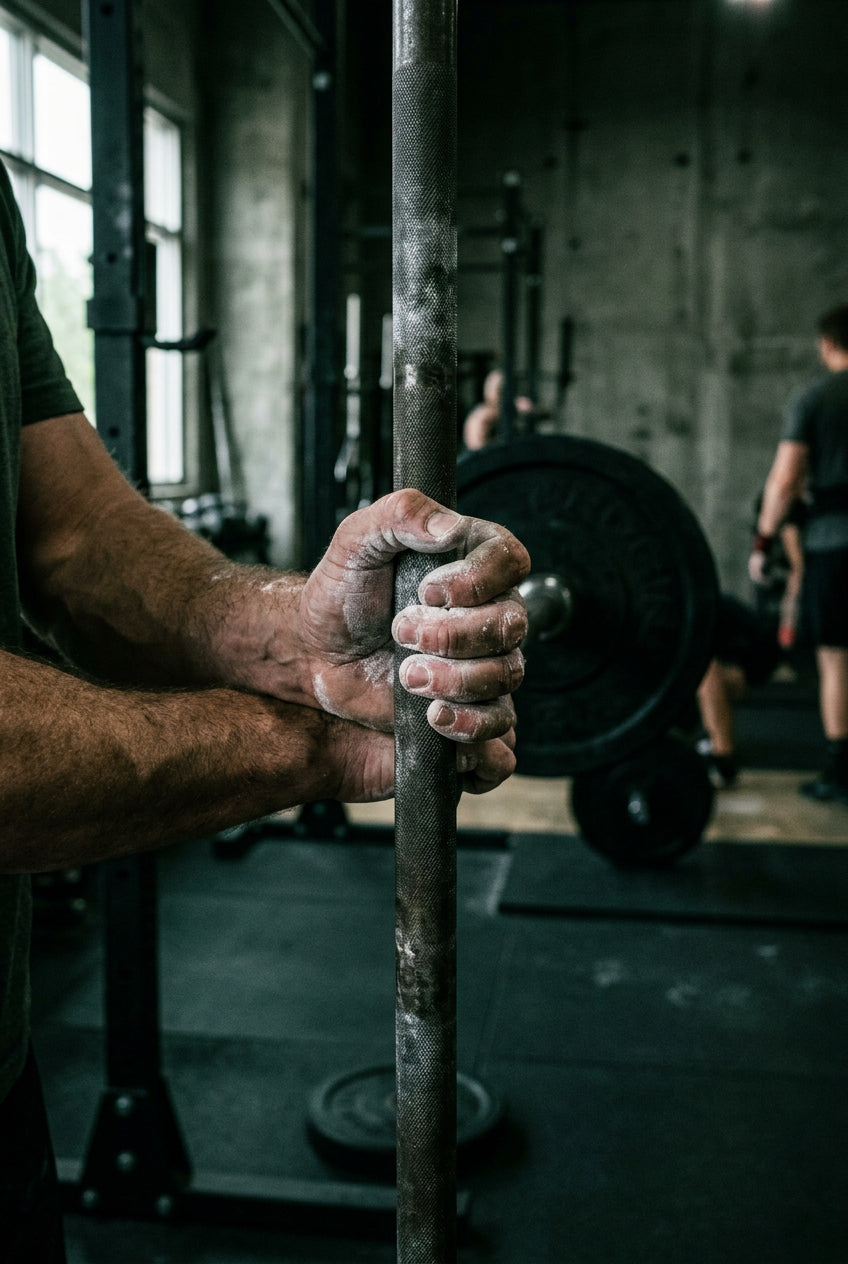
A dead hang is simply hanging from a bar with straight arms, and the science behind it is thinner than the internet suggests. Research shows a hang trains your grip and is a fair test of strength relative to your body weight. Bold claims like "it decompresses your spine," "it fixes shoulder impingement" or "a 2-minute hang predicts how long you'll live" have little or no direct evidence. Below: what a dead hang really trains, what the studies show, realistic hang times, progressions, who should be careful and a simple 4-week plan.
This article is general information, not medical advice. If you have shoulder, elbow or hand pain, or a health condition, check with a physician or physical therapist before you start hanging.
What does a dead hang actually train?
Mostly your support grip: the ability to keep holding on. Your finger flexors do the main work, but they aren't alone. In a 2026 lab study, 11 climbers hung from a bar until they let go. As fatigue set in, the forearm, biceps and trapezius muscles worked together differently to keep them on the bar, while the wrist moved less.[7] So a hang isn't just a "finger exercise." Your arms, shoulder blades and upper back all chip in.
Two things make hang time a slightly odd test:
- It's partly a body-weight test. In studies of the flexed-arm hang (a hang with your chin above the bar), results matched strength relative to body weight, not absolute strength.[1][2] A strong but heavy person can lose to a lighter, weaker one. That's not a flaw, just something to know before you compare yourself to anyone.
- It's partly a strength test. In 307 climbers, finger hang time was mostly explained by finger strength (65% of the variation in men, 80% in women), even though it's often used as an endurance test.[3]
Fun fact: back-and-upper-body endurance seems to matter as much as the fingers. In 28 advanced climbers, pull-up endurance predicted climbing level about as well as finger hang tests did.[8]
What research exists on dead hangs?
Less than you'd think, and almost all of it comes from three places: climbing, school fitness testing and the military.
Climbing studies (the best evidence)
- Hang training improves hang endurance. In 26 advanced sport climbers, 8 weeks of intermittent dead hangs on a small edge improved grip endurance by about 45%. Maximal weighted hangs improved it by about 34%.[6]
- Gains show up fast, but they're modest. In 23 competitive boulderers, 4 weeks of fingerboard training added about 5 to 7 seconds to their dead hang time and 2.5 kg (5.5 lb) to grip strength.[5]
- Hangs show fatigue. In 36 climbers at a 24-hour climbing competition, average hang time dropped from 76.8 seconds before the event to 38.1 seconds after it.[4]
The catch: these are young, fit climbers hanging from finger edges, not average adults on a pull-up bar.
School and military fitness tests
The flexed-arm hang (also called the bent-arm hang) has been a school fitness test for decades. A large European project pooled 2,779,165 test results from 30 countries to build age and sex norms for children aged 9 to 17. Boys scored clearly better than girls on strength and endurance tests.[10] In adults, a systematic review found moderate evidence that the bent-arm hang gives fairly consistent results when you repeat it.[9]
Fun fact: the U.S. Marine Corps used the flexed-arm hang for women until it switched to pull-ups on January 1, 2017. A study of nearly 50,000 female Marines found no overall jump in upper-body injuries after the switch.[11]
Important: a flexed-arm hang (chin over the bar, elbows bent) is not the same as a dead hang (arms straight). You can't use those norms for a dead hang.
What's missing
We could not find a peer-reviewed set of dead hang norms for ordinary adults, and no study linking dead hang time to health or lifespan. Grip strength on a dynamometer is linked to health outcomes (see our article on grip strength and longevity), but hang time is a different measure.
Myth vs. evidence
| Popular claim | What the research says |
|---|---|
| "Dead hangs build grip." | Supported. Hang training improves hang time and grip endurance in climbing trials.[5][6] |
| "Hang time is a pure endurance test." | Only partly true. It depends heavily on strength and on your body weight.[1][3] |
| "Hanging decompresses your spine and helps back pain." | Not shown. We found no study that measured the spine during a bar hang. Traction in general made little or no difference for low back pain in a Cochrane review of 32 trials.[16] A small pilot with an inversion table (24 patients) had fewer surgeries but no better pain or disability scores.[17] |
| "Hanging opens up space in the shoulder and fixes impingement." | Unproven. We found no trial of hanging for shoulder pain. Imaging shows the space under the shoulder roof changes with arm angle,[12][13] but "making more room" isn't the key anyway: surgery that shaves bone to create space did no better than placebo surgery.[14] |
| "We're built to hang, like apes, so it fixes desk posture." | A theory, not a finding. A 2026 paper argues for this idea but says itself that trials are still needed.[15] |
| "Hangboarding prevents climbing injuries." | Plausible, unproven. A 2026 review says there's a logical case but calls for randomized trials.[20] |
| "You should be able to hang 2 minutes for a long life." | No study found. This target circulates online, but we couldn't find any peer-reviewed source. Treat it as a fitness goal, not a health standard. |
How long should you be able to dead hang?
There's no research-based answer for adults. What follows is a Gripkind coaching rule of thumb, not a study result. It assumes a regular overhand grip on a pull-up bar, straight arms and an adult of average weight.
| Hang time (one go) | Rough level (rule of thumb) | What to do next |
|---|---|---|
| Can't hang yet, or under 10 s | Starting point | Assisted hangs with your feet on a box |
| 10–30 s | Beginner | Short sets, 3 times a week |
| 30–60 s | Solid | Add active hangs and longer sets |
| 60–90 s | Strong | Try towel or thick-grip hangs |
| 90 s or more | Very strong | Assisted one-arm work, if your shoulders are healthy |
For a real-world reference point: experienced endurance climbers averaged 76.8 seconds hanging from a wooden ledge before a 24-hour event, with a lot of spread between people.[4] If you weigh more, expect shorter times at the same strength.[1] Compare yourself with yourself, not with a stranger online.
Progressions: from assisted to one-arm
- Assisted hang. Stand on a box or low step and let your arms take only part of your weight. Great for beginners and for coming back after a break.
- Dead hang. Feet off the ground, arms straight, grip about shoulder-width, thumbs wrapped around the bar. (In a motion study of pull-ups, wide and reverse grips put the shoulder in positions linked to more impingement risk,[13] so shoulder-width is a sensible default.)
- Active hang. From a dead hang, pull your shoulder blades gently down and back so your body rises an inch or two, without bending your elbows. Hold. This keeps the shoulder muscles switched on.
- Scapular pulls. Slowly move between dead hang and active hang, 5 to 8 reps.
- Harder grip. Hang from towels or a thicker bar. A thicker handle makes holding on much harder (in one study, men could deadlift about 28% less on a 2-inch bar)[22], so start with short holds.
- Assisted one-arm hang. One hand on the bar, the other holding a towel or band for help.
- One-arm hang. Advanced. Only with healthy shoulders, an active shoulder (no hanging on your ligaments) and short holds.
Who should be careful
- Shoulder instability. If your shoulder has dislocated before, feels loose or "slips," or you're very flexible, ask a physical therapist first. With multidirectional instability the ball can slip out the bottom of the joint,[18] and a passive hang pulls in exactly that direction. Active hangs or assisted hangs may be a safer start, with professional guidance.
- Recent injury or surgery of the shoulder, elbow, wrist or hand. Wait for clearance from your surgeon or therapist.
- Pregnancy. ACOG notes that pregnancy hormones relax the ligaments around your joints, and that balance changes raise the risk of falling. It advises avoiding activities that may result in a fall.[19] Getting on and off a bar is a fall risk, so talk to your ob-gyn, and keep your feet on a box if you hang at all.
- Painful shoulder that won't go overhead (for example after a fall, or with a stiff, painful shoulder). Get it assessed before hanging.
- Elbow pain on the inside or outside (golfer's or tennis elbow). Long hangs can aggravate it. See our tennis elbow guide.
- Heart or blood pressure conditions. Ask your doctor, and don't hold your breath while hanging.
- Balance or bone problems. Use a low bar or a box so you never drop down.
Common mistakes
- Maxing out every session. Stop each set a few seconds before you'd have to let go. Save true max hangs for test days.
- Jumping up and dropping down. Step up from a box and step down onto it. An awkward landing is the easiest way to get hurt on a bar, and the easiest to avoid.
- Shrugging up to your ears and sagging. If a fully passive hang bothers your shoulders, switch to active hangs.
- Thumbless grip on day one. Wrap your thumbs around the bar until you're used to hanging.
- Holding your breath. Breathe slowly through the whole hang.
- Ignoring hand and finger pain. Tingling, numbness or sharp pain means stop, not "push through."
- Training through skin tears. Let torn calluses heal first. Chalk helps with sweaty hands.
A simple 4-week dead hang plan
Two to three sessions a week is plenty for most people. This plan uses three, on non-consecutive days (for example Monday, Wednesday, Friday), after a short warm-up. This is a coaching plan, not a research protocol. Use the pain rule many therapists use as a rule of thumb: mild discomfort up to about 3 out of 10 is OK if it settles by the next morning.
| Week | Each session | Rest between sets |
|---|---|---|
| 1 | Test once (stop when your grip starts to slip). Then 4 sets of assisted or dead hangs at about half your test time, plus 2 × 5 scapular pulls | 60–90 s |
| 2 | 4 sets at about 60% of your test time, plus 2 × 15–20 s active hangs | 60–90 s |
| 3 | 5 sets at about 60% of your test time, or 3 sets at about 75%, plus 2 × 6 scapular pulls | 90 s |
| 4 | Sessions 1 and 2: 3 easy sets at about 50%. Session 3: retest and write down your time | 90–120 s |
Can't hang 10 seconds yet? Do the whole plan as assisted hangs with your feet on a box, and use less foot help each week. After four weeks, fold hangs into a full grip routine: our how to build grip strength plan combines them with carries, wrist work and finger extensions.
Red flags: stop and get checked
See a physician or physical therapist if:
- You feel a pop, followed by sudden weakness, bruising or a bulge in the upper arm
- Your shoulder slips out of place or feels like it does
- Numbness or tingling in your hand or fingers doesn't go away after you let go
- You have pain at night, or pain that gets worse week after week
- Sharp pain in a finger, the palm or the elbow during or after a hang
Shoulder pain from sports and overhead work is covered in more detail in our shoulder and upper arm pain guide.
Fun facts and insights
- A school test that echoes later. In a small Finnish study that followed 45 people for 25 years, the flexed-arm hang that girls did at school in 1976 helped explain their adult fitness in 2001.[21] A tiny sample, but a nice reminder that habits stick.
- Grip and hang aren't the same thing. In the 24-hour climbing study, hang time roughly halved while grip strength dropped only about 15%.[4] Holding on for a long time and squeezing hard are different abilities.
Gear that fits this plan
You need a sturdy pull-up bar and, ideally, a box or step. That's it. When regular hangs get easy, fat grips slide onto a bar and make every hang harder for your hands. If you'd like a number that tracks grip strength (rather than hang time), a digital grip strength tester gives you one. See our grip strength by age chart to put it in context.
FAQ
Are dead hangs good for your shoulders?
For healthy shoulders, a controlled hang is generally a reasonable exercise, and active hangs train the muscles around the shoulder blade. But no trial has tested hangs for shoulder pain. If you have pain or instability, get a professional's advice first.
Do dead hangs decompress the spine?
Nobody has measured this during a bar hang, as far as we could find. Traction in general made little or no difference for low back pain in a large Cochrane review.[16] If hanging feels good for your back, fine, but don't expect it to fix a back problem.
Is a 60-second dead hang good?
By our coaching rule of thumb, yes: 60 seconds is solid to strong for most adults. There are no official adult norms, so use it as a personal benchmark rather than a health score.
Your dead hang checklist
- Step on and off from a box; never drop
- Shoulder-width overhand grip, thumbs wrapped
- Start assisted if you can't hang 10 seconds
- Stop sets a few seconds before failure; retest every 4 weeks
- Use active hangs if passive hangs bother your shoulders
- Instability, recent injury, pregnancy or red flags? Ask a physician or physical therapist first
- Build a daily habit with our free 7-day grip plan
Sources
- Clemons JM, Duncan CA, Blanchard OE, Gatch WH, Hollander DB, Doucet JL. Relationships between the flexed-arm hang and select measures of muscular fitness. J Strength Cond Res. 2004;18(3):630-636. PubMed · doi:10.1519/R-12342.1
- Pate RR, Burgess ML, Woods JA, Ross JG, Baumgartner T. Validity of field tests of upper body muscular strength. Res Q Exerc Sport. 1993;64(1):17-24. PubMed · doi:10.1080/02701367.1993.10608774
- Berta P, Michailov M, Kaško D, Gajdošík J, Běhounek M, Baláš J. Validity and normative scores of finger flexor strength and endurance tests estimated from a large sample of female and male climbers. J Sports Sci. 2025;43(3):245-255. PubMed · doi:10.1080/02640414.2024.2449316
- Yu E, Lowe J, Millon J, Tran K, Coffey C. Change in grip strength, hang time, and knot tying speed after 24 hours of endurance rock climbing. Front Sports Act Living. 2023;5:1224581. PubMed · doi:10.3389/fspor.2023.1224581
- Medernach JP, Kleinöder H, Lötzerich HH. Fingerboard in competitive bouldering: training effects on grip strength and endurance. J Strength Cond Res. 2015;29(8):2286-2295. PubMed · doi:10.1519/JSC.0000000000000873
- López-Rivera E, González-Badillo JJ. Comparison of the effects of three hangboard strength and endurance training programs on grip endurance in sport climbers. J Hum Kinet. 2019;66:183-195. PubMed · doi:10.2478/hukin-2018-0057
- Exel J, Kaufmann P, Froschauer O, Baca A, Kainz H, Mochizuki L. Upper-body neuromechanical coordination strategies during fatiguing sustained dead hangs in climbers. Eur J Sport Sci. 2026;26(6):e70197. PubMed · doi:10.1002/ejsc.70197
- Draga P, Rokowski R, Sutor A, Pandurevic D, Michailov ML. Importance of shoulder girdle and finger flexor muscle endurance in advanced male climbers. Front Sports Act Living. 2024;6:1410636. PubMed · doi:10.3389/fspor.2024.1410636
- Cuenca-Garcia M, Marin-Jimenez N, Perez-Bey A, Sánchez-Oliva D, Camiletti-Moiron D, Alvarez-Gallardo IC, et al. Reliability of field-based fitness tests in adults: a systematic review. Sports Med. 2022;52(8):1961-1979. PubMed · doi:10.1007/s40279-021-01635-2
- Tomkinson GR, Carver KD, Atkinson F, Daniell ND, Lewis LK, Fitzgerald JS, et al. European normative values for physical fitness in children and adolescents aged 9-17 years: results from 2 779 165 Eurofit performances representing 30 countries. Br J Sports Med. 2018;52(22):1445-1456. PubMed · doi:10.1136/bjsports-2017-098253
- Arnold B, Marneweck H, Banaag A, Coles CL, Koehlmoos TP. Trends in upper extremity injuries in female Marines following the addition of the pull-up as a physical fitness test event. Mil Med. 2026;191(9-10):e1817-e1823. PubMed · doi:10.1093/milmed/usaf621
- Giphart JE, van der Meijden OA, Millett PJ. The effects of arm elevation on the 3-dimensional acromiohumeral distance: a biplane fluoroscopy study with normative data. J Shoulder Elbow Surg. 2012;21(11):1593-1600. PubMed · doi:10.1016/j.jse.2011.11.023
- Prinold JA, Bull AM. Scapula kinematics of pull-up techniques: avoiding impingement risk with training changes. J Sci Med Sport. 2016;19(8):629-635. PubMed · doi:10.1016/j.jsams.2015.08.002
- Beard DJ, Rees JL, Cook JA, Rombach I, Cooper C, Merritt N, et al. Arthroscopic subacromial decompression for subacromial shoulder pain (CSAW): a multicentre, pragmatic, parallel group, placebo-controlled, three-group, randomised surgical trial. Lancet. 2018;391(10118):329-338. PubMed · doi:10.1016/S0140-6736(17)32457-1
- Ishibashi RF. Brachiation-based movement as a theoretical framework for addressing technology-related postural dysfunction: an evolutionary and neuromuscular perspective. J Bodyw Mov Ther. 2026;47:252-259. PubMed · doi:10.1016/j.jbmt.2026.03.008
- Wegner I, Widyahening IS, van Tulder MW, Blomberg SE, de Vet HC, Brønfort G, et al. Traction for low-back pain with or without sciatica. Cochrane Database Syst Rev. 2013;(8):CD003010. PubMed · doi:10.1002/14651858.CD003010.pub5
- Prasad KS, Gregson BA, Hargreaves G, Byrnes T, Winburn P, Mendelow AD. Inversion therapy in patients with pure single level lumbar discogenic disease: a pilot randomized trial. Disabil Rehabil. 2012;34(17):1473-1480. PubMed · doi:10.3109/09638288.2011.647231
- American Academy of Orthopaedic Surgeons (AAOS), OrthoInfo. Chronic Shoulder Instability. orthoinfo.aaos.org
- American College of Obstetricians and Gynecologists (ACOG). Exercise During Pregnancy (FAQ119; last updated September 2024, last reviewed November 2025). acog.org
- Kornienko K, Torkieh J, Shah K, Woodruff D, Raymond C, Chung M, et al. Hangboard training as a preventive strategy for upper extremity pathologies in rock climbers. Sports Health. 2026 (online ahead of print). PubMed · doi:10.1177/19417381261486277
- Mikkelsson L, Kaprio J, Kautiainen H, Kujala U, Mikkelsson M, Nupponen H. School fitness tests as predictors of adult health-related fitness. Am J Hum Biol. 2006;18(3):342-349. PubMed · doi:10.1002/ajhb.20498
- Ratamess NA, Faigenbaum AD, Mangine GT, Hoffman JR, Kang J. Acute muscular strength assessment using free weight bars of different thickness. J Strength Cond Res. 2007;21(1):240-244. PubMed · doi:10.1519/00124278-200702000-00043
Last updated: October 2026 · v1.1
Gripkind products are fitness and comfort accessories, not medical devices. They are not intended to diagnose, treat, cure or prevent any disease.