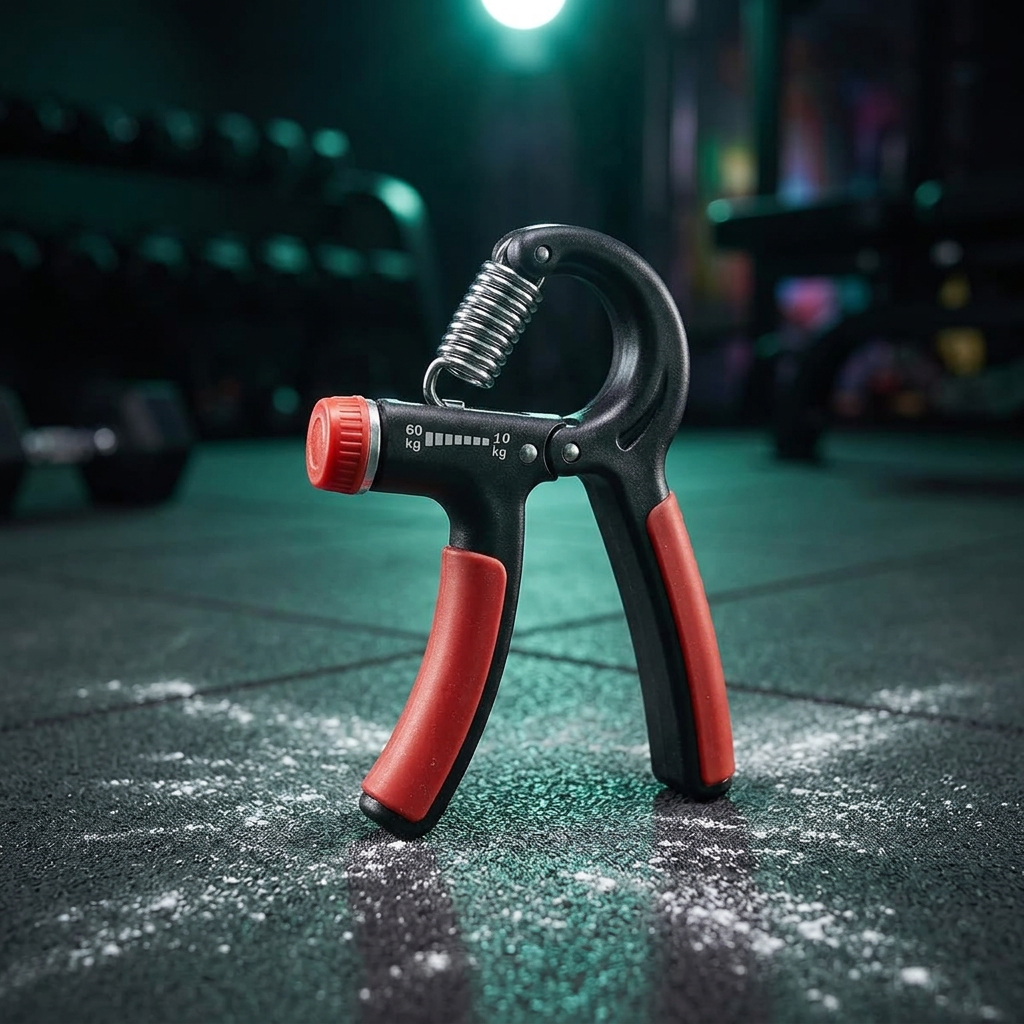
Which hand gripper should you buy? For most people, the best first gripper is an adjustable spring gripper set to a level you can close fully 10 to 15 times with control. Move to fixed heavy torsion grippers only when the adjustable one is easy at its top setting. And know this before you compare numbers: gripper ratings are not standardized, so a "100 lb" gripper from one maker can feel very different from another's. Below: the five types, how ratings work, a "start here" table, how to progress and the mistakes we see most.
This article is general fitness information. If you have hand, wrist or elbow pain, numbness or a recent injury, check with a physician or physical therapist before training grip hard.
The 5 types of grip trainers
| Type | How it works | Best for | Watch out for |
|---|---|---|---|
| Squeeze balls and rings | Soft foam, gel or silicone you compress | Beginners, older adults, warm-ups, desk breaks | Hard to measure progress; easy to outgrow |
| Finger trainers and extensor bands | Press single fingers, or open the hand against a band | Finger control, musicians, climbers, balancing all the squeezing | Not a crushing-strength tool |
| Adjustable spring gripper | A dial moves the spring to change resistance (ours: 22–132 lb, manufacturer rating) | Almost everyone starting out; one tool that grows with you | Rating changes along the dial; the closed position may still feel easy at low settings |
| Fixed heavy torsion grippers | A steel torsion spring between two metal handles, sold in levels | Strong hands, lifters, climbers, armwrestlers, strongman fans | Big jumps between levels; too heavy too soon is the #1 mistake |
| Digital grip tester (dynamometer) | Measures how hard you squeeze, in lbs or kg | Knowing your starting point and tracking progress | A measuring tool, not a trainer; compare only on the same device |
The point of a gripper is the same as any strength tool: enough resistance to challenge you, done regularly, raised over time. Strength guidelines for healthy adults recommend at least two sessions a week and two to three sets per exercise, and say training to failure isn't necessary.[1]
How do gripper resistance ratings work?
The short answer: the number on a gripper is a manufacturer's rating, and there's no shared industry test standard that we know of. That's why two grippers with the same number can feel different. Things that change the "real" difficulty:
- Where the force is measured. Basic lever physics: squeezing near the tips of the handles takes less force than squeezing close to the spring, so where your hand sits (and where a maker measures) changes the number.
- Handle span and your hand size. How wide the handles open matters. In a study of 70 adults, the grip span that produced maximum force depended on hand size in women, while for men a fixed span worked.[2] A gripper that opens wide is harder for small hands.
- Rating vs measured grip. A gripper rating is not the same as your dynamometer score. Closing a "100 lb" gripper doesn't mean you'll read 100 lb on a tester, or the other way around.
Our own grippers carry manufacturer ratings too. We list them honestly as such, and the practical fix is simple: judge a gripper by what you can close, not by the number.
Step 1: Measure your grip first
A quick test helps you pick a starting category and see progress later. Use the same device, posture and timing each time. In a classic reliability study, test-retest scores were most consistent when people used the average of three tries.[3]
Then compare your best score with a reference table. In a large UK study of 60,803 measurements, the median grip peaked at about 51 kg (112 lb) in men and 31 kg (68 lb) in women in their 30s and early 40s.[4] Our grip strength calculator shows your percentile for your age and sex, and the grip strength by age chart has the full table.
Step 2: Pick your starting level
These are Gripkind coaching guidelines, not research findings. "Close" means the handles touch, with control, for clean reps (no bouncing, no half-closes).
| If you can… | Start with… |
|---|---|
| …only squeeze a soft ball comfortably, or your hands are stiff or sore | A squeeze ball set (soft to firm) plus extensor bands. Move on when the firm ball is easy for 15 reps. |
| …close the adjustable gripper at its lowest setting fewer than 10 times | Stay at the lowest setting, 2–3 sets of as many clean reps as you can. Add one rep per week. |
| …close the lowest setting 10–15 times easily | The adjustable gripper at the setting where 10–15 clean reps feel hard but doable (effort 7/10). |
| …close a mid setting for 15+ reps and want variety | The 5-piece grip trainer set: gripper plus finger, extensor and forearm tools. |
| …close the adjustable at its top setting for 5+ clean reps | The heavy gripper set, starting with the lightest gripper, no matter what the numbers suggest. |
| …don't know your number yet | The digital grip strength tester first, then the adjustable gripper, so you can measure, then train. |
Why start the heavy set at the bottom? Because ratings from different gripper types and makers aren't comparable, the top of an adjustable gripper doesn't tell you which fixed level you can close. Start low, find out, then move up.
Step 3: Progress without wrecking your elbows
Tendons need time to adapt to heavier loads. Tendon studies show adaptation depends mostly on how heavy the load is, with somewhat larger effects in programs of 12 weeks or more.[5] Reviews of tendon biology also describe slow tissue turnover.[6] In practice:
- 2–4 sessions a week, with a rest day between hard sessions.
- Endurance range first (10–15 reps) for at least 4 weeks before heavy singles.
- Raise the dial one small step when you hit 15 clean reps on every set.
- Heavy grippers: low reps (3–5), long rests, and only a few hard sets.
- Balance each session with 2 sets of finger extensions on a band.
Our full plan is in how to build grip strength.
Common mistakes when buying and using a gripper
- Buying by ego. A gripper you can't close teaches you very little, and it's easy to overestimate your level.
- Comparing numbers across brands or types. Ratings aren't standardized; compare by feel and by what you can close.
- Training every day at max. Sore forearms and elbows are a sign to cut volume, not push through.
- Only squeezing. Skipping the opening muscles leaves your hand unbalanced; extensor bands take two minutes.
- Half reps. If the handles don't touch, it doesn't count. Lower the setting instead.
- Ignoring pain. Pain on the outside or inside of the elbow can be the start of tennis or golfer's elbow. Back off and see our tennis elbow exercises to avoid.
FAQ
What hand gripper is best for beginners?
An adjustable spring gripper is the most flexible first choice: it starts light and grows with you. If your hands are stiff, sore or arthritic, begin with squeeze balls and extensor bands, then move to the gripper when the firm ball feels easy for 15 reps.
What does a "100 lb gripper" actually mean?
It's the manufacturer's rating of the force needed to close it, measured their way. There's no common test standard we know of, so a 100 lb rating from one maker may feel easier or harder than another's. Use it as a rough guide, and judge by what you can close.
How often should I use a hand gripper?
Two to four times a week is enough for most people, with rest days between hard sessions. Strength guidelines for adults suggest at least two sessions a week with two to three sets. Daily light squeezing is fine; daily max effort is not.
Can a gripper cause tennis elbow?
Doing too much, too heavy, too soon can irritate the tendons around the elbow. Start light, progress slowly and stop if you feel pain on the outside or inside of the elbow that lingers into the next day. If it doesn't settle, see a physician or physical therapist.
Do I need a grip tester if I have a gripper?
Not strictly, but it helps. A tester gives you a number to compare with age norms and to track over months. A gripper tells you what you can close, which is useful for training but isn't a standardized measurement.
Your gripper checklist
- Measure first (or use the calculator with a friend's tester)
- Start where 10–15 clean closes feel hard but doable
- Judge by what you can close, not by the number on the label
- 2–4 sessions a week; extensor bands every time
- Heavy set only after the adjustable's top setting is easy, starting with the lightest
- Elbow pain that lingers? Back off and get it checked
- Build the habit with our free 7-day grip plan
Sources
- Currier BS, D'Souza AC, Singh MAF, Lowisz CV, Rawson ES, Schoenfeld BJ, et al. American College of Sports Medicine Position Stand. Resistance training prescription for muscle function, hypertrophy, and physical performance in healthy adults: an overview of reviews. Med Sci Sports Exerc. 2026;58(4):851-872. PubMed · doi:10.1249/MSS.0000000000003897
- Ruiz-Ruiz J, Mesa JL, Gutiérrez A, Castillo MJ. Hand size influences optimal grip span in women but not in men. J Hand Surg Am. 2002;27(5):897-901. PubMed · doi:10.1053/jhsu.2002.34315
- Mathiowetz V, Weber K, Volland G, Kashman N. Reliability and validity of grip and pinch strength evaluations. J Hand Surg Am. 1984;9(2):222-226. PubMed · doi:10.1016/s0363-5023(84)80146-x
- Dodds RM, Syddall HE, Cooper R, Benzeval M, Deary IJ, Dennison EM, et al. Grip strength across the life course: normative data from twelve British studies. PLoS One. 2014;9(12):e113637. PubMed · doi:10.1371/journal.pone.0113637
- Bohm S, Mersmann F, Arampatzis A. Human tendon adaptation in response to mechanical loading: a systematic review and meta-analysis of exercise intervention studies on healthy adults. Sports Med Open. 2015;1(1):7. PubMed · doi:10.1186/s40798-015-0009-9
- Magnusson SP, Kjaer M. The impact of loading, unloading, ageing and injury on the human tendon. J Physiol. 2019;597(5):1283-1298. PubMed · doi:10.1113/JP275450
Last updated: October 14, 2026 · v1.1
Gripkind products are fitness and comfort accessories, not medical devices. They are not intended to diagnose, treat, cure or prevent any disease.