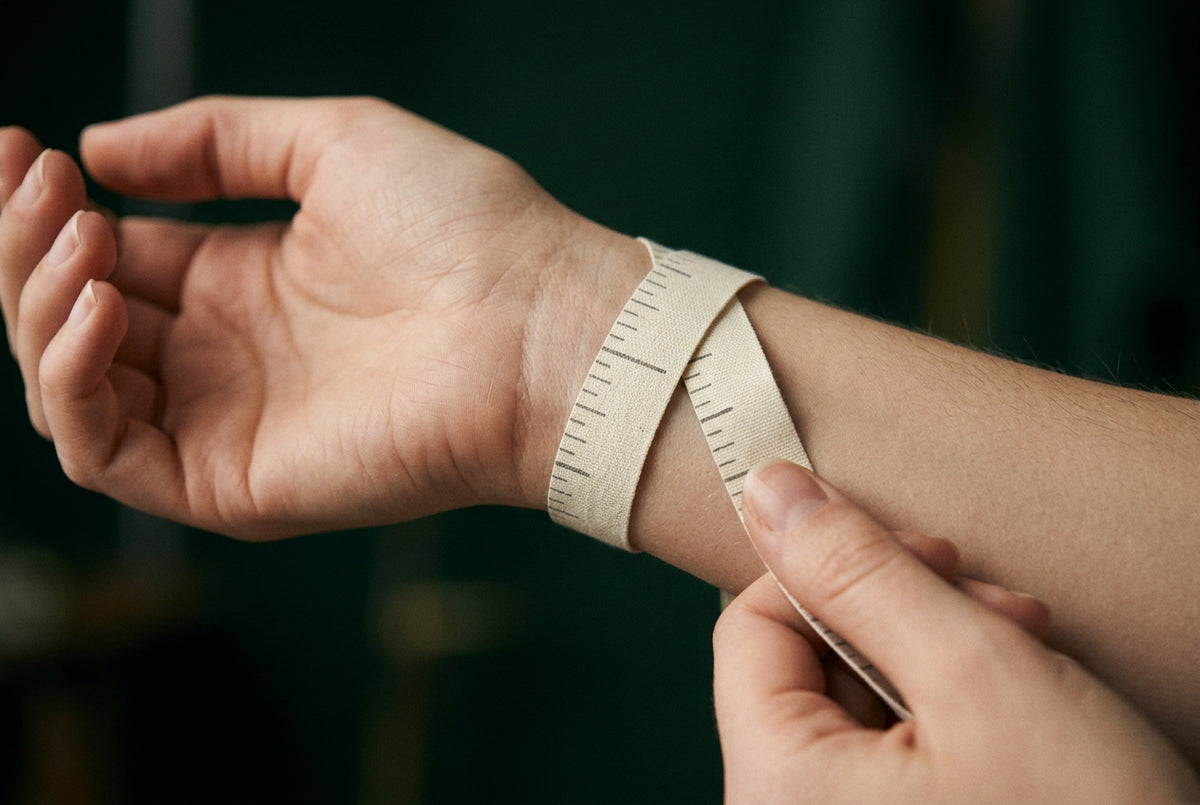
Can you make your wrists bigger? Mostly, no. Wrist size is set mainly by your bones (the ends of the radius and ulna and the small carpal bones), and bone shape is largely inherited. That's why doctors use wrist circumference as a marker of frame size. Years of heavy loading can make bone a bit thicker and denser, but that's a small change you won't really see. What you can change is the forearm right above the wrist: the wrist flexors, extensors and brachioradialis grow with training. Below: what the research says, a 2–3× a week routine, and how to measure your progress.
This article is general information, not medical advice. Wrist pain, swelling, clicking with pain, numbness or tingling: see a doctor or physical therapist before training.
Why your wrist size is mostly fixed
It's your frame
Your wrist is a ring of bone, ligaments and tendons. At the wrist crease there are no big muscle bellies: the forearm muscles have already turned into tendons there. So a tape measure at the wrist mostly measures bone. That's exactly why it's used to estimate body frame. MedlinePlus (US National Library of Medicine) sorts adults into a small, medium or large frame by wrist circumference and height. For men over 5'5", for example, a wrist of 6.5–7.5 inches counts as a medium frame and over 7.5 inches as large.[1] Wrist circumference is also one of the standard frame-size measures in research on children and teens.[2]
Bone size is largely in your genes
In a twin study of 161 pairs of middle-aged women, genetic factors explained 47–68% of the differences in bone structure at the distal radius, the end of the forearm bone that forms your wrist.[3] Genes aren't everything, but they set most of the frame you're working with.
Bone does adapt, but slowly and modestly
Bone isn't dead tissue. The classic proof comes from racquet players, who load one arm far more than the other. In 12 former national-level male tennis players, the playing arm had 16–21% more bone cross-sectional area in the upper arm and forearm bone than the other arm.[4] But look at the context:
- The extra bone mineral in the playing arm was two to four times bigger in female players who started at or before puberty than in those who started more than 15 years later.[5]
- Right at the wrist end of the radius, 57 tennis players had only about 5% more bone area on the playing side; the bigger difference there was in density (about 8%).[6]
- These are years of daily, high-impact hitting, not a few months of curls.
So yes, loading changes bone. But for an adult who starts training now, expect small changes, mostly in bone density and wall thickness. A few percent more bone area is hard to see with a tape measure (that's our reasoning, not a measured result). Training is great for your bones; it just won't turn a small frame into a large one.
What you CAN change: the forearm above your wrist
Muscle is a different story. The same racquet players also had clearly more lean (mostly muscle) tissue in the playing forearm, and their bone area tracked with grip strength.[7] In a 12-week MRI study of untrained adults doing dumbbell curls twice a week, the brachioradialis (the muscle on the thumb side of your forearm) grew by 13.5–17.6%, mostly in its upper and middle part.[8]
That last detail matters: forearm muscle bulk sits in the upper two-thirds of the forearm. Training won't add much right at the wrist bone, but it does build a thicker forearm that tapers into your wrist. Visually, "big wrists" is often really "big forearms".
How to make forearm muscles grow
- Enough volume. A meta-analysis found a graded dose-response: more weekly sets, more muscle growth.[9] The 2026 American College of Sports Medicine position stand found hypertrophy was enhanced by 10 or more sets a week per muscle.[10]
- Progressive overload. Add a rep, a small amount of weight, or a step on your gripper when sets get easy.
- 2–3 sessions a week. Spread the sets out instead of doing them all in one day.
- Space hard sessions. Not because forearm muscles are slow to recover, but because in adults the core of a tendon renews very slowly, if at all.[11] A day between heavy sessions is a sensible rule of thumb.
The routine: 3 moves + 2 extras
| Exercise | Main target | Sets × reps | How often |
|---|---|---|---|
| Wrist curls (palm up, forearm on bench or thigh) | Wrist flexors (inside of forearm) | 3 × 12–20 | 2–3× a week |
| Reverse wrist curls (palm down) | Wrist extensors (top of forearm) | 3 × 12–20, lighter | 2–3× a week |
| Hammer curls (thumbs up) | Brachioradialis | 3 × 8–12 | 2–3× a week |
| Adjustable hand gripper | Finger flexors, grip | 2–3 × 8–15 per hand | 2–3× a week |
| Farmer carries (dumbbells or heavy bags) | Whole grip + forearm | 3 × 30–40 s walk | 1–2× a week |
Gripkind training guidelines based on the sources above, not a medical prescription. At 3 sessions a week that's 9 sets per wrist move, and well over 10 hard sets a week for the forearm as a whole once you add the gripper and carries. Use a weight you can control through the full range, lower slowly, and stop each set 1–2 reps before your form breaks.
New to grip work? Start with how to build grip strength. Picking a gripper level? See which hand gripper should I buy. And if your forearms don't get sore, that's fine: soreness isn't a progress meter.
How to measure (and what to track)
Wrist and forearm with a tape
- Use a soft tape measure. Wrap it around the wrist just below the bony bump on the pinky side, toward your hand. Snug, not tight.
- Measure the forearm at its widest point, arm relaxed and straight, hand open.
- Same arm, same time of day (morning works), once a month.
Expect the wrist number to stay about the same. The forearm number is the one that can move.
Grip strength with a tester
Tape changes are slow and small, so track strength too. Once a week, same position, three tries per hand, write down the best. The digital grip strength tester ($49.95) measures 0–180 kg (0–396 lb), reads to 0.1 kg and remembers 19 users. It's a fitness device, not a medical test. Compare your number with others your age in the grip strength calculator. To train, the adjustable hand gripper ($22.95) dials from 22 to 132 lb, so you can keep adding load as you get stronger.
FAQ
Can you increase wrist size?
Only a little. Wrist size is mostly bone, and bone size is largely genetic. Long-term heavy loading makes bone slightly bigger and denser, but the change is small. Your forearm muscles, just above the wrist, can grow much more.
Do wrist curls make your wrists bigger?
They make your forearms bigger, not the wrist bones. Because the muscle bellies sit higher up, the effect shows as a thicker forearm that tapers into the wrist.
How long until I see bigger forearms?
In one MRI study, the brachioradialis grew about 14–18% in 12 weeks of twice-weekly curls in untrained adults.[8] Visible change usually takes a couple of months of consistent, progressive training.
Is a small wrist a sign of weakness?
No. Frame size and strength are different things. People with small wrists can build a strong grip; track your grip number, not your wrist size.
Should I train forearms every day for faster results?
Not hard. Two to three heavy sessions a week with a day in between is plenty, mainly because tendons adapt slowly. Light warm-ups can be done more often.
Sources
- MedlinePlus Medical Encyclopedia. Determining body frame size. US National Library of Medicine; reviewed 7/23/2024. medlineplus.gov
- Guzman-de la Garza FJ, Cerino Peñaloza MS, García Leal M, et al. Anthropometric parameters to estimate body frame size in children and adolescents: a systematic review. Am J Hum Biol. 2022;34(6):e23720. PubMed · doi:10.1002/ajhb.23720
- Bjørnerem Å, Bui M, Wang X, et al. Genetic and environmental variances of bone microarchitecture and bone remodeling markers: a twin study. J Bone Miner Res. 2015;30(3):519-527. PubMed · doi:10.1002/jbmr.2365
- Haapasalo H, Kontulainen S, Sievänen H, Kannus P, Järvinen M, Vuori I. Exercise-induced bone gain is due to enlargement in bone size without a change in volumetric bone density: a peripheral quantitative computed tomography study of the upper arms of male tennis players. Bone. 2000;27(3):351-357. PubMed · doi:10.1016/s8756-3282(00)00331-8
- Kannus P, Haapasalo H, Sankelo M, et al. Effect of starting age of physical activity on bone mass in the dominant arm of tennis and squash players. Ann Intern Med. 1995;123(1):27-31. PubMed · doi:10.7326/0003-4819-123-1-199507010-00003
- Ducher G, Prouteau S, Courteix D, Benhamou CL. Cortical and trabecular bone at the forearm show different adaptation patterns in response to tennis playing. J Clin Densitom. 2004;7(4):399-405. PubMed · doi:10.1385/jcd:7:4:399
- Ducher G, Jaffré C, Arlettaz A, Benhamou CL, Courteix D. Effects of long-term tennis playing on the muscle-bone relationship in the dominant and nondominant forearms. Can J Appl Physiol. 2005;30(1):3-17. PubMed · doi:10.1139/h05-101
- Kobayashi Y, Maeo S, Eihara Y, et al. Exercise-specific preferential hypertrophy of individual elbow flexor muscles after incline versus preacher dumbbell curl training. J Sports Sci. Published online October 4, 2026. PubMed · doi:10.1080/02640414.2026.2741751
- Schoenfeld BJ, Ogborn D, Krieger JW. Dose-response relationship between weekly resistance training volume and increases in muscle mass: a systematic review and meta-analysis. J Sports Sci. 2017;35(11):1073-1082. PubMed · doi:10.1080/02640414.2016.1210197
- Currier BS, D'Souza AC, Singh MAF, et al. American College of Sports Medicine Position Stand. Resistance training prescription for muscle function, hypertrophy, and physical performance in healthy adults: an overview of reviews. Med Sci Sports Exerc. 2026;58(4):851-872. PubMed · doi:10.1249/MSS.0000000000003897
- Svensson RB, Heinemeier KM, Couppé C, Kjaer M, Magnusson SP. Effect of aging and exercise on the tendon. J Appl Physiol. 2016;121(6):1237-1246. PubMed · doi:10.1152/japplphysiol.00328.2016
Last updated: October 14, 2026 · v1.0
Gripkind products are fitness and comfort accessories, not medical devices. They are not intended to diagnose, treat, cure or prevent any disease.